
Coaxial Cable Loss in Practice – How the Wrong Cable Eats Your Power
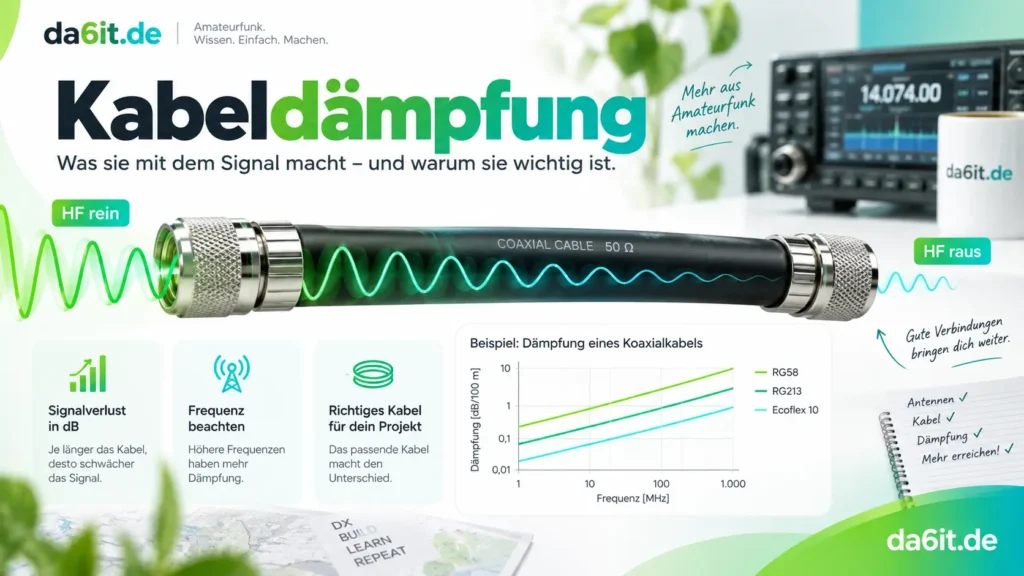
Learn how coaxial cable loss can turn most of your transmitted power into heat, how to calculate it, and which cable is right for your frequency, length, and power level.
You set your transmitter to 100 W, see a perfect SWR, and wonder why the range suddenly drops. The culprit is often the cable between the transceiver and the antenna. Coaxial cable loss can turn a large part of your transmitted power into heat and also distort the measured SWR. This article explains what cable loss is, how to calculate it, and which cables suit which applications.
What is cable loss?
Coaxial cable loss is the loss of signal energy that occurs as an HF signal travels from one end of the cable to the other. The loss is expressed in decibels (dB) and can be given as either voltage loss or power loss.
Physical causes
A coaxial cable consists of a center conductor, a dielectric, and an outer conductor. Each part contributes to the total loss:
- The center and outer conductors act like tiny antennas and radiate a portion of the electrical power.
- The dielectric incurs losses through dielectric heating – the material converts part of the electrical energy into heat.
- The ohmic resistance of the conductors (conductor loss) also causes energy loss.
The higher the frequency, the stronger these effects become, because the electromagnetic fields oscillate faster and radiate more energy into the surroundings.
How much loss in practice?
The two most important variables are frequency and cable length. At low frequencies (e.g., 10 MHz) the loss remains small even for long runs. On VHF (144 MHz) and UHF (430 MHz) it rises rapidly.
Frequency and length dependence
Most manufacturers specify loss per 100 m. To obtain the loss for your actual length, multiply the specified value by the length in metres and divide by 100:
Total loss (dB) = (Loss per 100 m / 100) × Cable length (m)Example: a cable rated at 7 dB/100 m and 30 m long has a total loss of 2.1 dB.
Example: 100 m RG58 at 144 MHz
RG58 is a thin, widely used cable. At 144 MHz its loss is about 17.8 dB per 100 m. That means:
- Input power: 100 W (20 dBm)
- Loss: 17.8 dB → Output power ≈ 1.3 W
Almost 99 % of the power is turned into heat in the cable. A lower‑loss cable such as Ecoflex 10 (≈ 4.8 dB/100 m) would deliver roughly 33 W under the same conditions – a difference you would notice immediately in the field.
Calculating loss – your practical tool
The calculation formulas are straightforward:
- Power loss:
d = 10·log10(P₁/P₂) dB - Voltage (or amplitude) loss:
d = 20·log10(U₁/U₂) dB
For most applications the power formula is sufficient. You only need the input and output power (or the loss per 100 m) and the cable length. If you want it even faster, use the coax loss calculator from DA6IT – it does the conversion and instantly gives you the result in dB and remaining power.
Why SWR can be misleading
A common misconception is that a low SWR automatically means a good antenna system. That isn’t always true. The cable attenuates not only the forward‑going power but also the power reflected back from the antenna. A heavily lossy cable (e.g., a long RG58) can absorb the reflected wave almost completely, so the SWR meter at the transmitter shows a seemingly perfect 1:1. When you replace that cable with a low‑loss type, the reflected power is less attenuated and the measured SWR rises – even though more power actually reaches the antenna. This effect is often called the “SWR illusion.”
Cable choice – when is RG58 sufficient?
RG58 is cheap and flexible, but its loss climbs sharply with frequency and length. For short patch cables in the shack (e.g., 2 m at 10 MHz) it is perfectly adequate. For VHF/UHF runs longer than about 20 m it quickly becomes a power‑eater. Alternatives include:
- RG213/U – thicker cable, loss about 7–8 dB/100 m at 144 MHz, suitable for up to 1 kW.
- Ecoflex 10 – modern, very low loss (≈ 4.8 dB/100 m), but stiff and more expensive.
- Aircell variants – lower loss than RG58, but mechanically more delicate.
The decision depends on three factors: frequency, cable length, and maximum transmit power.
Comparison of common cable types (loss at 144 MHz)
Type          | Loss (dB/100 m) | Max Power (W) | Remarks
--------------|----------------|---------------|--------------------------
RG174A/U      | 31–38          | 100           | Very thin, QRP use
RG58C/U       | 17.8–20.8      | 275           | Common all‑purpose cable
RG213/U       | 7.2–8.5        | 1100          | Robust, high‑power
Aircell 7     | 7.9 (or 13.6)  | –             | Low‑loss, small bend radius
Ecoflex 10    | 4.8–4.9        | –             | Very low‑loss, stiff
Values for Aircell 7 vary between sources; when in doubt, check the latest data sheet from the manufacturer.
Mechanical aspects and installation
Low‑loss cables are often thicker and less flexible. Ecoflex 15, for example, requires a minimum bend radius of 150 mm, whereas RG58 can bend around 25 mm. When routing cables through tight conduit or around sharp corners you must respect the bend radius, otherwise micro‑cracks can form, increasing loss and shortening the cable’s life.
Another practical tip: place antenna tuners and pre‑amplifiers as close to the antenna as possible. Every extra connector between tuner/pre‑amp and antenna adds more loss. If you have a long feed line, mount the tuner on the mast – this reduces total loss and improves overall efficiency.
Conclusion & decision guide
Cable loss is not an optional factor; it is a central part of any HF setup. On the shortwave bands a simple RG58 patch cable can be sufficient because the loss is negligible. On VHF, UHF and higher frequencies the cable quickly becomes the bottleneck – especially with long runs and high power.
Before you pick a cable, answer three questions:
- Which frequency (or frequency range) will you use?
- How long is the run between transceiver and antenna?
- How much power do you intend to transmit?
If you are running more than 20 m of cable at 144 MHz and want to transmit over 50 W, choose a cable with less than 8 dB/100 m – for example RG213 or Ecoflex. For short connections inside the shack, RG58 is fine as long as you stay out of the UHF band.
Use the coax loss calculator to evaluate your specific situation. It will instantly tell you whether your current cable is still adequate or if you should upgrade to a low‑loss model.
More amateur radio, technology and practical articles are available on DA6IT.de.