
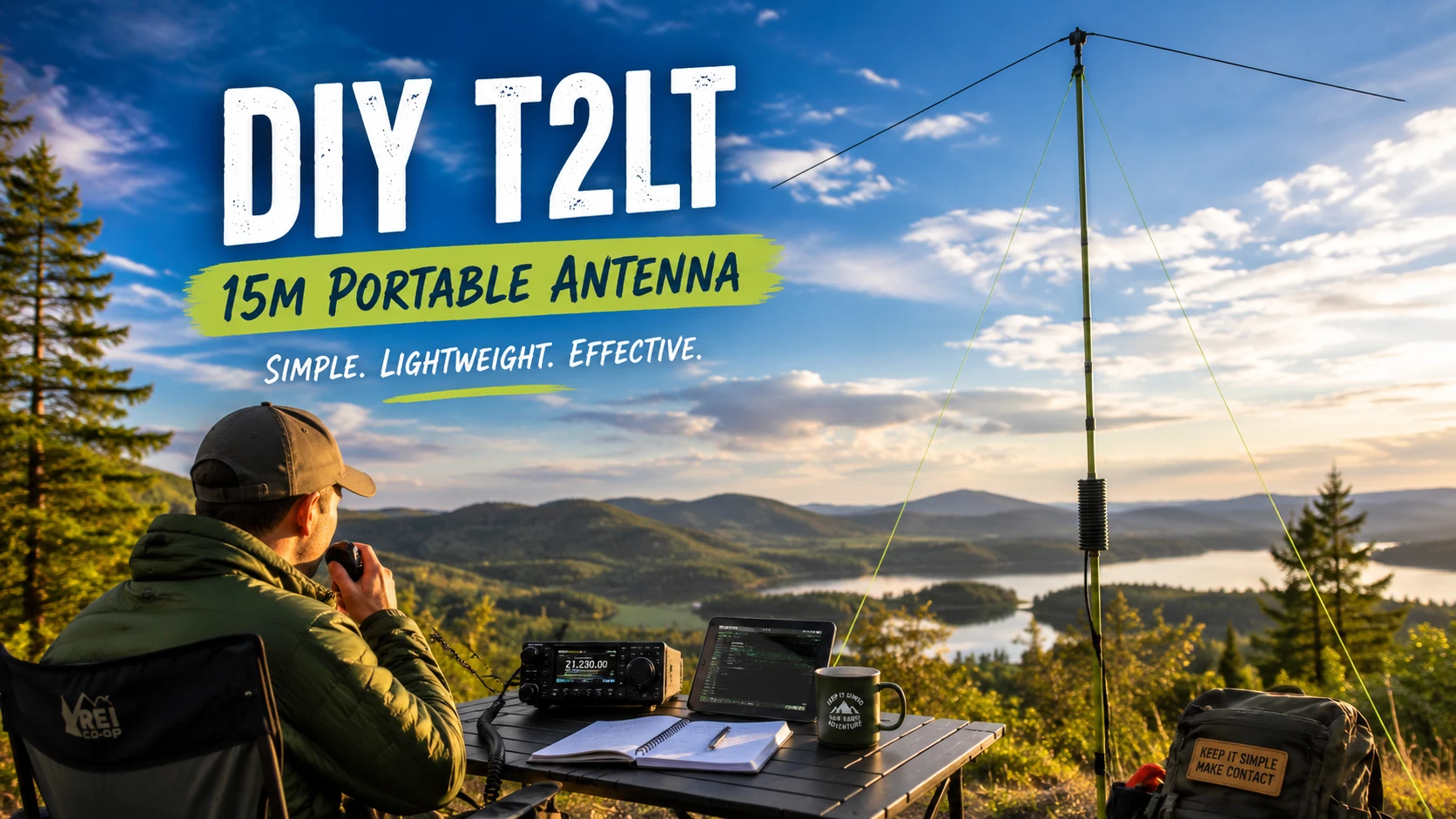
When it comes to a simple, affordable and portable wire antenna, the T2LT is a real favourite for me. I do not want to pretend that I have done a scientific comparison against dozens of other antennas – I have not. But out of the antennas I have personally used so far, the T2LT on 15 metres is clearly the one that has worked best for me.
That is exactly what makes it so attractive to me: it is probably one of the cheapest antennas I can build myself with very little material. A length of coax, a small choke coil, a few cable ties and a mast are basically enough. At the same time it does not just work “somehow” here – it works really well, especially on 15 metres and especially for portable operating.
What a T2LT actually is
The T2LT is, at its core, a very simple coax-based wire antenna. The upper section forms the actual radiator, another coax section works below that, and further down a common-mode choke or coil separates the active antenna section from the feed line.
For 15 metres, this is a very nice compromise for me between effort, cost and real-world performance. The antenna is light, quick to build and quick to raise, which is exactly what I want when I do not feel like carrying a complicated system with me.
What I used for the build
- RG58 C/U or similar coax cable
- a PL plug or whatever connector matches the station
- a piece of HT pipe or an HT coupler as the former for the choke coil
- cable ties or tape to hold everything in place
- a fibreglass mast or another light support for portable use
- optionally a NanoVNA or at least some way to check SWR
The materials already show why I like the T2LT so much: there is almost nothing expensive about it. For a portable antenna, the price-performance ratio is excellent from my point of view.
My build step by step
I built my own T2LT in a very practical way: at the top I stripped around 3.6 metres. Below that I kept another roughly 3.6 metres before the actual coil or choke begins.
For the coil, this is what I use: on a normal piece of HT pipe, about seven turns fit well. I personally built my version on an HT coupler, and there it ended up being six turns. Because the diameter changes, the result is naturally not identical.
And that is also the most important note: these dimensions are a good starting point for me, but not holy law. With a T2LT it really pays to test, measure and experiment a little. Coil diameter, number of turns, installation height and surroundings all influence the outcome. So I would not expect to copy numbers blindly and instantly end up with a perfect antenna.
Raising it and using it portable
This is where the T2LT shows one of its biggest strengths for me. The antenna is light, mechanically uncomplicated and easy to raise on a fibreglass mast. For POTA, a spontaneous trip or simply operating outdoors, that is almost ideal in my eyes.
What I really like is that the T2LT never feels like a massive project. No giant structure, no heavy hardware, no complicated mechanics – just an antenna that is quickly ready to go. That is exactly why I find it so charming for portable use.
Why it works so well for me on 15 metres
My personal experience is very clear: on 15 metres, this antenna performs extremely well for me. I have not compared it to countless other antenna types under perfectly identical conditions. But in my real everyday operating, the T2LT on 15 metres is the antenna that has impressed me the most so far.
That is why I like it so much despite the very simple design. It is not only cheap and light – it also delivers real results for me. And in the end, that is what matters.
Measure, adjust, improve
As with almost any antenna, a little fine-tuning never hurts. If resonance is not exactly where I want it, or if the SWR can still be improved, I prefer to adjust things in small steps instead of rebuilding everything at once. A NanoVNA is extremely helpful for seeing such differences quickly.
And honestly, with a T2LT this little bit of testing and tinkering is simply part of the fun for me. That is part of what makes it so satisfying.
My conclusion
If I had to name a cheap, lightweight and very practical portable antenna for 15 metres, the T2LT would be right at the top of my list. It costs very little, can be built quite easily and performs surprisingly well on 15 metres in my own operating.
I would absolutely build one again. Not because it is theoretically the perfect antenna for every situation, but because in practice it gives me exactly what I want: simple deployment, little luggage and really good results on 15 metres.