MeshCore – the Decentralized LoRa Mesh for Emergency and Hobby Use
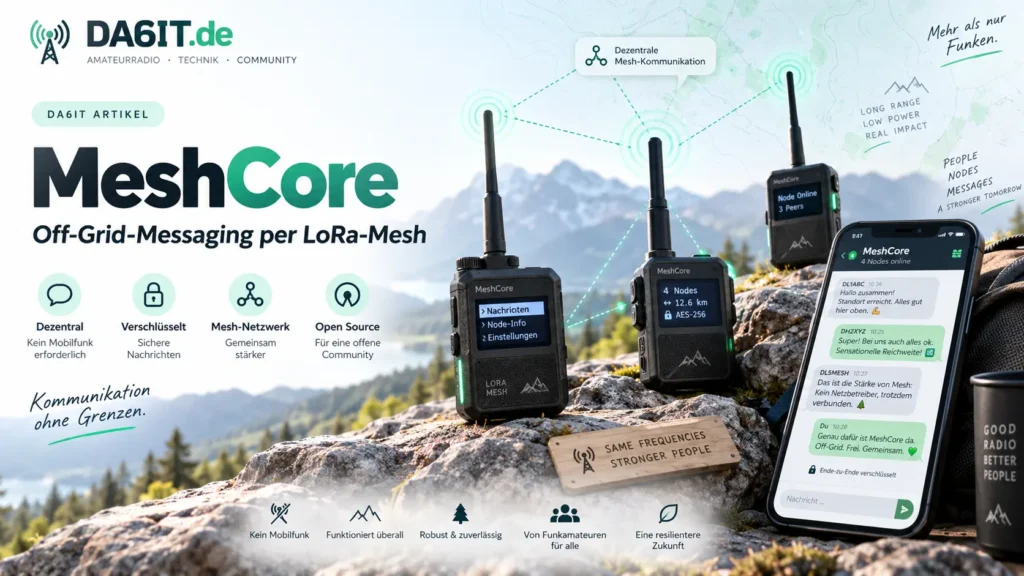
MeshCore is an open, decentralized LoRa‑based mesh that lets you exchange short text messages and GPS data over several kilometres without any Internet, cellular or Wi‑Fi infrastructure.
Imagine the mobile network goes down, the power grid disappears, and you can still share short text messages and location data with others. That’s exactly what MeshCore provides – an open, decentralized communication system built entirely on LoRa radio, requiring no Internet, cellular service, or Wi‑Fi.
When the network fails
The real‑world blackout in Berlin in early 2026 showed how quickly the entire digital infrastructure can collapse. Without functioning cellular or fixed‑network base stations, a smartphone becomes a pure GPS device – you can’t place calls, send data, and you’re cut off from the outside world in an emergency. In such situations a self‑contained radio network that operates independently of central stations is a decisive advantage. MeshCore is designed for exactly that: a local, autonomous mesh that transports messages over several kilometres using LoRa radios.
What is MeshCore?
MeshCore is an open‑source system released in 2024 as a continuation of Meshtastic. The firmware and associated libraries are licensed under the MIT license, so anyone can view, modify, and redistribute the code. Technically the system relies on LoRa (Long Range) technology, known for very long distances with extremely low power consumption. In Europe MeshCore uses the license‑free SRD band at 868 MHz, in North America the ISM band around 915 MHz. No radio licence is required because it falls under the so‑called “personal radio” (unlicensed) regulations.
Communication is limited to short text messages (maximum 237 characters), GPS coordinates, and status information such as battery level or signal quality. Private chats and channels use AES‑256 encryption, so only authorized recipients can read the content. Public channels are unencrypted, because they are intended to be readable by anyone in the mesh.
The technology behind it: intelligent routing
The key difference to older systems like Meshtastic lies in the routing algorithm. Meshtastic uses a flood approach: every node repeats each received packet until it reaches its destination. This quickly saturates the frequency band, especially in densely populated areas. MeshCore, by contrast, dynamically determines the most efficient path to the target device and stores that route as long as the network topology remains unchanged. This saves airtime, reduces interference, and markedly improves delivery rates.
The three roles in the mesh
- Clients (Companions): handheld devices you use to write and receive messages. They usually connect via Bluetooth or USB to a smartphone or laptop that runs the MeshCore app.
- Repeater: devices that act solely as relay stations. They forward data packets selectively and extend the network’s range. Repeaters are detected automatically and added to the routing tables.
- Room Server: optional dedicated servers that store message histories within groups permanently. For pure emergency use this is not required.
MeshCore in a disaster – why it’s ideal for emergency communications
The greatest strength of MeshCore is its complete independence from any infrastructure. Without a cellular mast, fiber optic cable, or satellite link, nodes can communicate over several kilometres. Coupled with solar‑powered repeaters, a network can run autonomously for days, weeks, or even months. The LoRa chipsets draw only microamps, so a small solar panel with a buffer battery is sufficient to keep a repeater powered continuously.
In an emergency MeshCore provides a dedicated SOS signal. The signal is treated with priority status and broadcast to all reachable nodes in the network. The protocol also returns acknowledgements (ACKs), so you know immediately whether your call for help arrived. These mechanisms are built into the firmware and need no extra configuration.
Range depends heavily on terrain and obstacles. Under optimal conditions (open field, clear line of sight) LoRa signals exceed 10 km; in mountainous or urban areas 8–24 km is common. Strategically placed repeaters – for example on rooftops, church towers, or masts – can push effective ranges beyond 30 km. That means a well‑planned mesh can connect whole towns or rural regions without a central backbone.
Hardware and getting started – how to join the network
MeshCore runs on the same inexpensive LoRa boards that are already popular in the Meshtastic community. Common models include the Heltec V3/V4, the LilyGo T‑Beam, the T‑Deck, the T‑Echo, and the RAK WisBlock series. All of these devices contain an integrated LoRa chip, a microcontroller (usually an ESP32), and a connector for a GPS antenna.
If you prefer not to solder, ready‑made handsets such as the MeshCore M9 are available. The M9 features a physical keyboard, its own operating system (MeshOS), and can be configured directly via the MeshCore app. In Germany the M9 is not yet widely stocked, so building one yourself with a Heltec board remains the most practical option.
Flashing the firmware is extremely simple thanks to a web‑based flash tool: open the page in a browser, select the appropriate binary file (v1.17.1, released 14 August 2026), and start the flash process. The whole procedure takes less than five minutes. Afterwards install the Companion app on your smartphone (Android, iOS, Windows, macOS, Linux) and pair the device via Bluetooth. It is advisable to back up the firmware file and the app installer offline so you can get started without Internet access in an emergency.
Limitations you should know
MeshCore is not a general‑purpose chat platform. The maximum message length is 237 characters, and only text, GPS coordinates, and system status can be transmitted. Images, audio files, or larger data packets are technically impossible because the LoRa band is not designed for such volumes.
Because messages may travel over several hops, latency is introduced. In a small network with few nodes a message can arrive in a few seconds; in a larger, heavily loaded mesh it may take several minutes. For SOS calls this is acceptable, as the priority handling of the SOS signal speeds up delivery.
Another common misunderstanding is that every device automatically acts as a repeater. In MeshCore a device must be explicitly configured as a repeater. Without enough repeaters, coverage drops rapidly, especially in densely built‑up areas.
Encryption applies only to private channels and direct messages. Public channels remain unencrypted because they are meant to be readable by anyone in the mesh. If you need to exchange confidential information, always use a private channel.
Conclusion: Take communication into your own hands
MeshCore gives you a robust, infrastructure‑independent means of communication that is purpose‑built for emergencies and crises. With minimal power consumption, simple hardware, and an intelligent routing algorithm you can set up a self‑sufficient mesh that keeps working even when public networks fail. For amateur radio operators looking to make their gear crisis‑proof, MeshCore is a worthwhile building block – and a fascinating open‑source project for anyone who enjoys tinkering with software.
More amateur radio, technology and practical articles are available on DA6IT.de.