
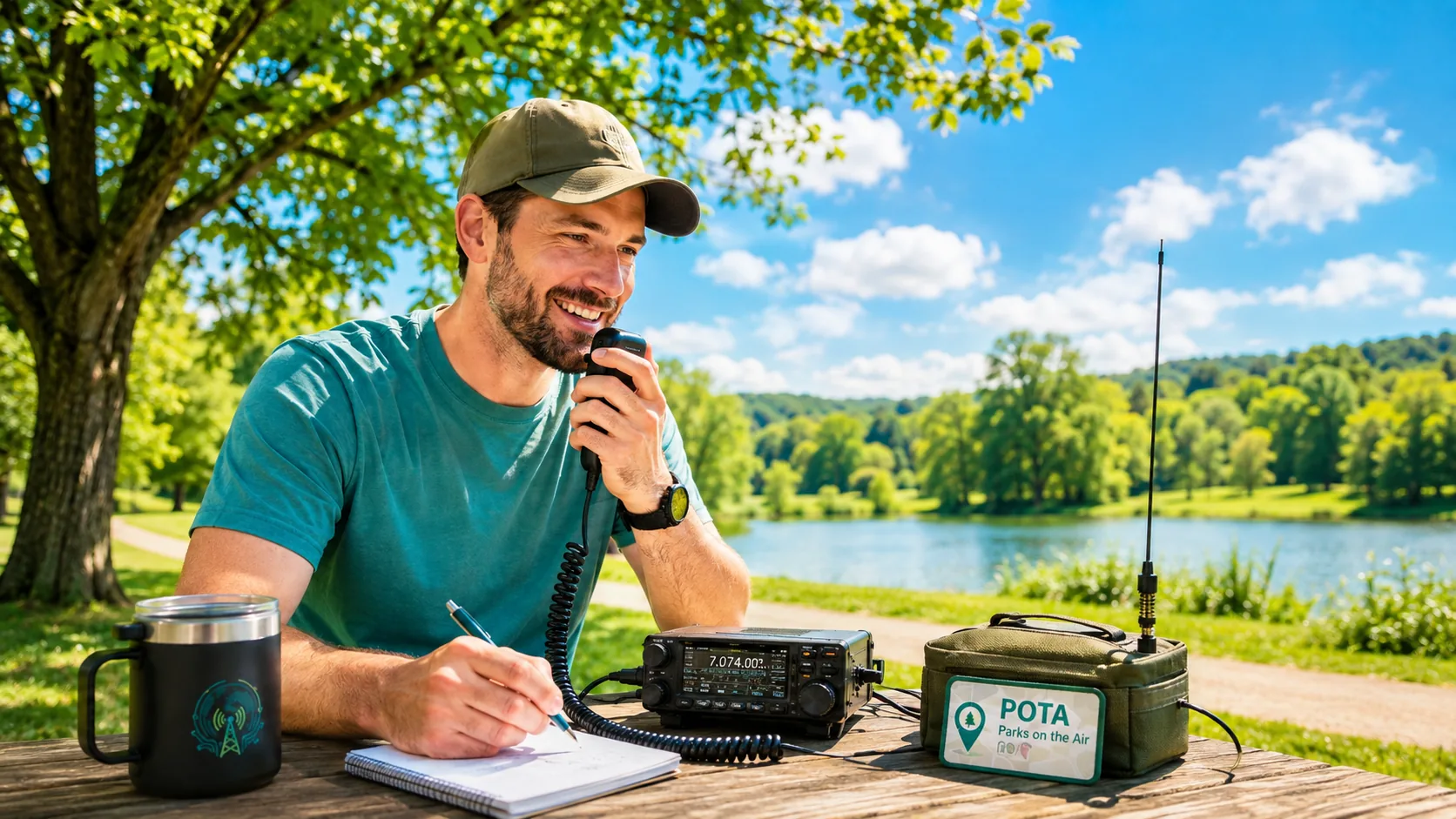
POTA stands for Parks on the Air, and for me it is one of the most enjoyable ways to operate amateur radio portable. The idea is simple: I take a small radio station to a listed park, set it up and make QSOs from there. No huge field-day station and no truckload of equipment – at its simplest, a radio, battery, portable antenna and something to log with are enough.
When you first open pota.app, the park references, spots and Activator/Hunter statistics can make the whole system look more complicated than it really is. For a first activation, only a few basics matter.
POTA in one sentence
With POTA, radio amateurs operate from officially listed parks while other operators try to contact them. The station in the park is the Activator; the station working the park is the Hunter.
The easiest way to get started does not require portable equipment at all. I can open the current spots on pota.app, tune to an active station and make the contact from home. That already makes me a Hunter.
Hunter or Activator – what is the difference?
- Hunter: I contact a POTA station from home, mobile or any other location.
- Activator: I am inside a valid POTA park with my complete station and operate from there.
- Park-to-Park: Two Activators contact each other from their respective parks.
Hunters do not upload their own logs to POTA. Their credit comes from the Activator’s submitted log. Activators, on the other hand, submit an ADIF log after the activation.
What do I really need for a first activation?
I would keep the first POTA activation deliberately small. A complicated setup usually creates more possible failure points than benefits. A relaxed first outing can be done with:
- a radio I already know well
- a suitable power source, for example a small LiFePO4 battery
- a simple portable antenna
- coax and only the adapters I actually need
- a microphone, key or equipment for the chosen mode
- a logging method – paper is perfectly fine for a first activation
- some time, a suitable operating spot and a valid POTA park
Everything else can be added later. I actually prefer a small setup: it is faster to deploy, easier to carry and produces far less cable clutter. POTA should be fun, not an exercise in moving half the shack into a park.
Finding a suitable park
The POTA map makes it easy to find parks and references. For the exact operating location, however, I do not rely on the POTA map alone. The official POTA guidance recommends verifying park boundaries using official park sources or other reliable mapping information.
For a normal activation, I and my complete station must be inside the park boundary. That includes the radio, antenna and the rest of the equipment. Local park rules still apply, of course. Before putting wires in trees, guy lines across an area or stakes into the ground, I check what is actually permitted at that location.
How my first POTA activation would work
1. Choose the park and operating spot
I choose an easily accessible park, verify the boundaries and look for a place where I can sit and deploy the antenna without getting in anyone’s way. For a first attempt I would avoid a location where the setup itself already feels like an expedition.
2. Set up a small station
Radio, battery and antenna are enough to start. I quickly check SWR, power and audio or PTT, and once the station is working the actual radio operation can begin.
3. Find a clear frequency and call CQ
On SSB I listen first, ask whether the frequency is in use if necessary, and then start calling. It does not need to be complicated. For example:
CQ POTA, CQ POTA, this is DA6IT portable, DA6IT portable, Parks on the Air.
4. Add a spot
A spot on pota.app makes portable operation much easier. Hunters can see my callsign, park, frequency and mode and tune straight to me. With a small portable station that visibility is a real advantage.
5. Make QSOs and keep a clean log
A successful activation requires at least 10 QSOs within one UTC day. If I finish with fewer than ten, the log is still worth submitting: POTA encourages logs from unsuccessful attempts as well, so the Hunters still receive credit for their contacts.
What is exchanged in a POTA QSO?
POTA does not require a complicated formal exchange. For a normal contact, a callsign and a proper signal report are enough. A name, location or short greeting is often added. I like that: a POTA QSO can be quick and efficient without having to feel like a contest.
For Park-to-Park contacts I also record the other station’s park reference. That makes correct P2P matching in the ADIF log much more reliable.
SSB, CW, FT8 and other modes
POTA is not tied to one operating mode. SSB is a very approachable way to start because the workflow is immediately understandable. CW is highly efficient with low power and compact stations. Digital modes such as FT8 can also be useful when conditions are difficult or when deliberately operating with limited power.
For a first activation I would still choose a mode I already know well. A park is not the ideal place to learn five unfamiliar radio menus, software packages and cable connections at the same time.
Logging and ADIF
As an Activator I submit my log to POTA in ADIF format. For a straightforward activation, the essential information includes my station or operator callsign, the contacted callsign, date and time in UTC, band and mode. The official POTA Logging Made Easy guide explains the required fields in detail.
Whether I log digitally in the park or use paper first is mostly a matter of station style. Paper has one major advantage: it always works. The QSOs can be entered into logging software later and exported as ADIF.
Park-to-Park is especially fun
When I contact another POTA Activator from my own park, the result is a Park-to-Park QSO. Both stations are Activator and Hunter at the same time. I like to pick up these contacts whenever possible because they capture the portable character of POTA particularly well.
What I would avoid on the first outing
- Too much equipment: I would rather use a small setup I know.
- Unverified park boundaries: the POTA map is useful, but not the only source for an exact boundary.
- Untested power: I want to know roughly how long the battery lasts before leaving home.
- Complicated antenna experiments: for the first activation I prefer something that has already worked.
- Forgetting the log: even a small pileup quickly shows why clean logging matters.
- Putting myself under pressure: an attempt with fewer than ten QSOs is still useful operating experience.
Useful POTA links
- pota.app – parks, spots, statistics and log upload
- POTA Documentation – official documentation
- POTA Rules – current rules
- Activator Guide – planning and running an activation
- Logging Made Easy – ADIF and logging
Conclusion
For me, POTA is exactly the right mix of amateur radio, portable operation and spending time outdoors. Getting started is much easier than all the park references, spots and statistics may suggest at first. A first activation does not require a huge antenna or half a shack in the car.
A small radio, power, a working antenna, a log and a suitable park are enough. The rest is best learned exactly where POTA happens: outside, with the microphone in my hand and the next QSO going into the log.