
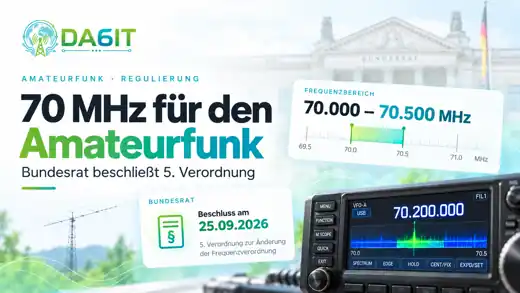
There is movement around Germany’s 4-metre band: on 25 September 2026, the Bundesrat approved the Fifth Ordinance amending the Frequency Ordinance. For radio amateurs, the most interesting part is the range from 70.000 to 70.500 MHz. The amendment creates a regulatory framework for amateur-radio use there, but it is not yet an immediate permission to transmit.
That distinction matters. A headline can easily sound as if 70 MHz has already been opened again for German amateur stations. It has not. The Bundesrat has completed an important regulatory step, while formal promulgation and the concrete operating conditions still have to follow.
What did the Bundesrat decide on 25 September 2026?
The Bundesrat approved the Fifth Ordinance amending the Frequency Ordinance. Germany’s Frequency Ordinance assigns frequency ranges to radio services at national level. It therefore provides part of the legal framework on which the Federal Network Agency, the Bundesnetzagentur, bases the more detailed frequency plan and concrete usage conditions.
Bundesrat document 364/26 contains a national provision for the 70 MHz range. It provides a framework under which 70–70.5 MHz can be used for emissions by the amateur service. Amateur use does not receive protection from military radio services in this range and must not cause harmful interference to them.
Why 70 MHz is interesting for amateur radio
The 70 MHz allocation is commonly known as the 4-metre band. It sits between the familiar 6-metre band around 50 MHz and the 2-metre band at 144 MHz. From a propagation perspective, that makes it an interesting part of VHF. During suitable conditions, especially in the summer Sporadic-E season, signals around 70 MHz can support surprisingly long contacts across Europe.
The important point in the new Frequency Ordinance is structural: instead of relying only on temporary special permissions, Germany is preparing a more durable regulatory basis for amateur-radio operation in this range. The exact usable spectrum and operating conditions will only become clear in the next regulatory steps.
Important: do not transmit on 70 MHz yet
The Bundesrat decision by itself does not automatically extend an individual German amateur-radio authorisation. The Bundesnetzagentur explains that an amateur-radio authorisation permits use of the frequency ranges listed in Annex 1 of the German Amateur Radio Ordinance, subject to the operating conditions and the licence class shown on the authorisation.
The currently valid Bundesnetzagentur frequency plan is dated August 2026 and entered into force on 26 August 2026, before the Bundesrat decision of 25 September. The new framework therefore still has to be reflected in the subsequent regulatory provisions. Formal promulgation and updated operating conditions are among the steps that still have to take place.
In practical terms: the regulatory framework has taken an important step forward, but there is not yet a published transmission start date defining power, modes and eligible German licence classes.
Which operating conditions are still open?
The Frequency Ordinance does not answer every question that matters for day-to-day amateur operation. The later Bundesnetzagentur provisions and any necessary changes to the amateur-radio rules will determine the practical details.
- Licence classes: will 70 MHz be available only to Class A, or also to Class E?
- Actual spectrum: will the full 70.000–70.500 MHz range be usable, or only part of it?
- Transmit power: what maximum ERP or transmitter power will apply?
- Bandwidth and modes: which emission types and occupied bandwidths will be permitted?
- Operating location: will there be restrictions to fixed amateur stations, or will portable and mobile operation be possible?
- Protection of military users: what concrete requirements will follow from amateur use having no protection and being required not to cause harmful interference?
Looking back at Germany’s previous temporary 70 MHz permission
Transmitting on 70 MHz is not entirely new in Germany. The Bundesnetzagentur previously issued a temporary permission under Decision 105/2024. That permission ran until 31 December 2025 and was much narrower: 70.150 to 70.210 MHz, Class A only, fixed amateur stations only, a maximum of 25 W ERP, up to 12 kHz occupied bandwidth and horizontal polarisation.
The 2026 amendment is therefore especially significant as an overarching framework. It refers to the wider 70 to 70.5 MHz range, but that does not mean German amateurs will automatically receive all 500 kHz under unrestricted conditions. The final practical allocation may still be narrower and subject to detailed limits.
What happens next?
The next places to watch are the Federal Law Gazette and, above all, future publications by the Bundesnetzagentur. Those will contain the details that actually determine legal amateur operation: who may transmit, from which date, with which power and in which part of the 4-metre band.
For now, the position is straightforward: 70 MHz has moved an important step forward in Germany’s regulatory process, but amateur stations should still wait for the concrete authorisation before transmitting.