Amateur Radio 2026: Numbers, Trends and License Classes
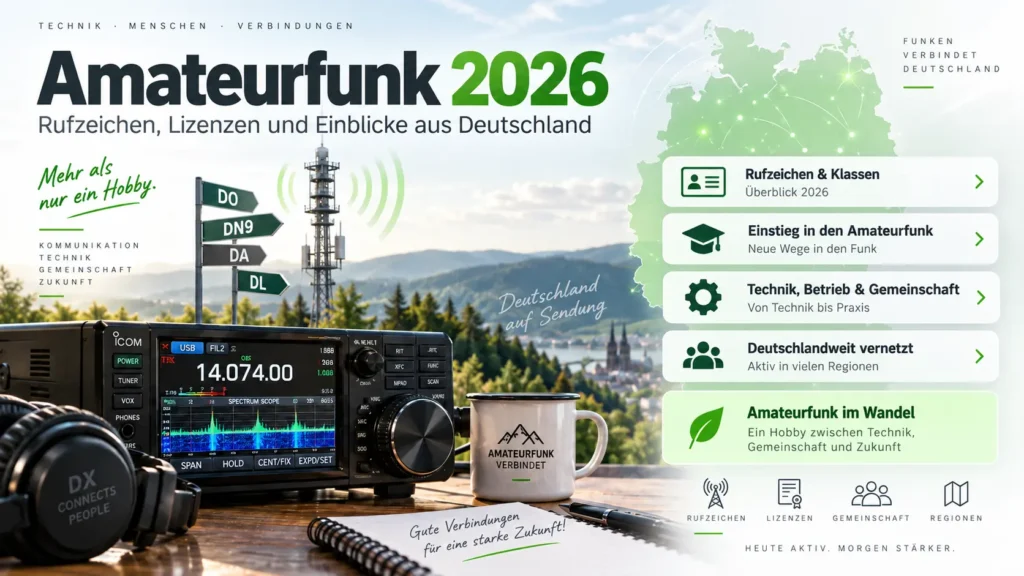
Germany still hosts about 61 000 licensed amateur radio operators, but the new Entry‑Class N is reshaping the community. This article examines the latest statistics, newcomers' interests, and a possible modular exam model to support the next generation.
The current statistics from the Federal Network Agency show that Germany, with about 60,900 licensed amateur radio operators, remains one of the largest amateur radio communities in Europe. At the same time the licensing system is evolving: the class N introduced in 2024 brings fresh air, while the classic class A continues to shrink. This article looks at what the numbers mean for the next generation, what interests new members bring, and whether the existing license classes still match today’s needs.
Current figures and development since 2024
As of 14 September 2026 there are 60,918 individual call signs. Of these, 50,471 belong to Expert class A, 9,303 to Novice class E and 1,144 to Entry class N. In addition, by the end of 2025 roughly 2,912 club stations, 1,435 repeaters and 4,786 training call signs had been allocated, bringing the total number of allocated call signs to 70,238.
The trend is clear: while class N has grown from 293 call signs in December 2024 (its launch in June 2024) to 1,144 in September 2026, class A lost 1,516 call signs in the same period, mainly due to age‑related retirements. Class E gained about 450 call signs over the same time. The total count of licensed amateurs fell slightly from 61,104 in December 2025 to 60,918 in September 2026.
Exam numbers confirm the upward trend in the entry classes: in 2025 there were 2,261 exam applications, of which 753 candidates passed class N, 706 passed class E and 631 passed class A. Compared with the low point of 1,000 examinees in the COVID year 2021, the participant number has more than doubled.
Demographic framework
The average age of German amateur radio operators is about 60 years, with the main age group between 50 and 75. The proportion of women is estimated at 5‑15 %. Internationally, Germany ranks fourth in Europe with roughly 61,000 licensed operators, behind the United Kingdom, France and Italy. With one amateur radio operator per 1,400 inhabitants, the figure is moderate by international standards.
Interests of new members: practice rather than home‑brewing?
Several observations from recent years indicate that many newcomers are primarily interested in getting on the air quickly. They want to operate right away, use digital modes such as FT8 and take part in portable activities (e.g., POTA – Parks on the Air). Modern commercially built transceivers dominate the equipment: models like the Icom IC‑7300, the IC‑7110 or the Kenwood TM‑D750 are frequently mentioned. The focus is on operating technique, logging and using repeater or direct links, not on designing their own circuits.
At the same time there remains an active group that is enthusiastic about circuit design, electronics and building their own radios. This tradition has been a core part of amateur radio since its beginnings, but an increasing number of beginners no longer see it as the first step. The observation that home‑brewing is no longer front‑and‑center cannot be quantified precisely, but the sharply rising number of class‑N call signs, which only permit operation on 10 m, 2 m and 70 cm, points to a practice‑oriented entry.
Classes N, E and A compared
The three license classes differ in band access, power limits and technical exam scope:
- Class N (Entry‑Class): call signs with the prefix DN9xxx, limited to 10 m, 2 m and 70 cm. The exam covers basic operating knowledge, regulations and a basic‑technology module.
- Class E (Novice‑Class): call signs DA6, DO1‑DO9. In addition to the N content, expanded bands and higher power are unlocked. The technical part requires deeper knowledge, but not to the level of class A.
- Class A (Expert‑Class): call signs from DA1 to DM9. Full access to all amateur bands and maximum power. The technical exam is comprehensive and includes detailed knowledge of electronics, circuit design, EMC fundamentals and regulatory requirements.
All classes share the same sections on operating knowledge and regulations; the difference lies solely in the technical part.
Is technical knowledge mandatory for all license classes?
The central question is: does every amateur who only wants to operate a commercially built transceiver need the same deep electronics and circuit knowledge as someone who builds their own transmitters or final amplifiers? The current exam structure suggests that the class A exam demands a high technical level, while classes N and E deliberately set lower hurdles.
Some arguments favour a more differentiated approach:
- Safe and responsible operation requires basic knowledge of EMC, frequency use and emergency communications – these are already included in all classes.
- In‑depth electronics and circuit knowledge is essential for home‑brewing, troubleshooting one’s own gear and advancing radio technology, but not mandatory for pure operating.
- The rising number of class‑N call signs shows that lower entry barriers attract people who might otherwise never discover amateur radio.
At the same time it must not be overlooked that a solid technical understanding underpins compliance with safety and regulatory requirements. The challenge is therefore to clearly separate necessary basic knowledge from advanced specialist knowledge.
Author’s assessment
I increasingly get the impression that many people today mainly want to make contacts. Building a complete transceiver is no longer the first thing for many. That’s why I wonder whether class A in its current form presents an unnecessarily high hurdle for some interested parties.
This opinion is based on the observed number trends and feedback from the DARC forums, but it should not be presented as proven fact. It is intended to spark a discussion about whether exam contents could become more modular in the future – for example a basic module for safe operation and an optional advanced module for home‑brewing and deeper electronics.
Modern exam models: a possible direction
A modular exam approach could look like this:
- Basic Module: operating knowledge, regulations, fundamentals of radio technique and EMC. Mandatory for all license classes.
- Extension Module E: advanced antenna techniques, digital modes and expanded bands. Prerequisite for class E.
- Advanced Module A: detailed electronics and circuit theory, building amplifiers, measurement and fault safety. Prerequisite for class A.
Such a model would lower the entry barrier for practice‑oriented amateurs without diluting the high quality standards for home‑brewing. At the same time the possibility to qualify through the advanced module would remain for those whose interest in building grows.
Impact on the next generation
If the goal is to attract more active amateurs in the long term, training offers and licensing paths must accommodate the different interests. The introduction of class N has already shown that a lower entry point appeals to people who might otherwise have no access to amateur radio. By allowing later upgrades to higher classes, a development path remains that captures both operation‑focused and technically ambitious members.
Another aspect is the new training regulation: the training operation now runs under the instructor’s call sign with the suffix “/T” or “/Trainee” and mandatory logging is no longer required. This simplification reduces administrative hurdles and could increase the attractiveness of training programs.
Conclusion and outlook
The 2026 figures make clear that German amateur radio is at a turning point. While the classic class A continues to shrink, the new class N brings fresh growth. The trend toward a practice‑oriented entry is evident, and the current exam structure already reflects this development – albeit not completely.
A possible further development could be a modular exam model that clearly separates basic and advanced knowledge. That would meet the needs of beginners who want to start transmitting immediately, without compromising the high technical standards for home‑builders. Such adjustments could, over time, help strengthen the next generation and keep the German amateur radio community viable for the future.
More amateur radio, technology and practical articles are available on DA6IT.de.