
The words “amateur radio exam” can sound like advanced electronics, endless formulas and a room full of engineers. Germany’s Class N entry licence is designed to make that picture much less intimidating.
Introduced on 24 June 2024, Class N teaches the important basics, leads to a real amateur-radio callsign and lets you start transmitting on the 10m, 2m and 70cm bands.
What can Class N operators use?
- 10m: 28.000–29.700 MHz
- 2m: 144–146 MHz
- 70cm: 430–440 MHz
The maximum radiated power is 10 W ERP on 10m and 10 W EIRP on 2m and 70cm. That is enough to learn local operating, repeaters, antennas and – when propagation cooperates – surprisingly long-distance contacts on 10 metres.
What does the exam look like?
There are three sections: operating practice, regulations and Class N technical knowledge. Each paper has 25 questions with up to 45 minutes available. The Federal Network Agency publishes the official question catalogue, so you are not studying for an unknown black box.
The main difference between Germany’s N, E and A licences is the depth of technical knowledge. Operating and regulations remain important at every level, while Class N deliberately starts with the fundamentals.
You do need to learn – but you do not need to be an engineer
Frequency and wavelength, voltage and current, basic antennas, SWR, transmitters, receivers, modulation and safe power supplies are typical topics. They make much more sense when you connect them to a real radio instead of treating them as abstract school physics.
Morse code is not a mandatory part of the normal licence exam. You can discover CW later if you want to.
A free learning path already exists
The DARC platform 50ohm.de offers a complete Class N course. Official questions, current exam information and dates are available directly from the Bundesnetzagentur.

Your first station does not need to be huge
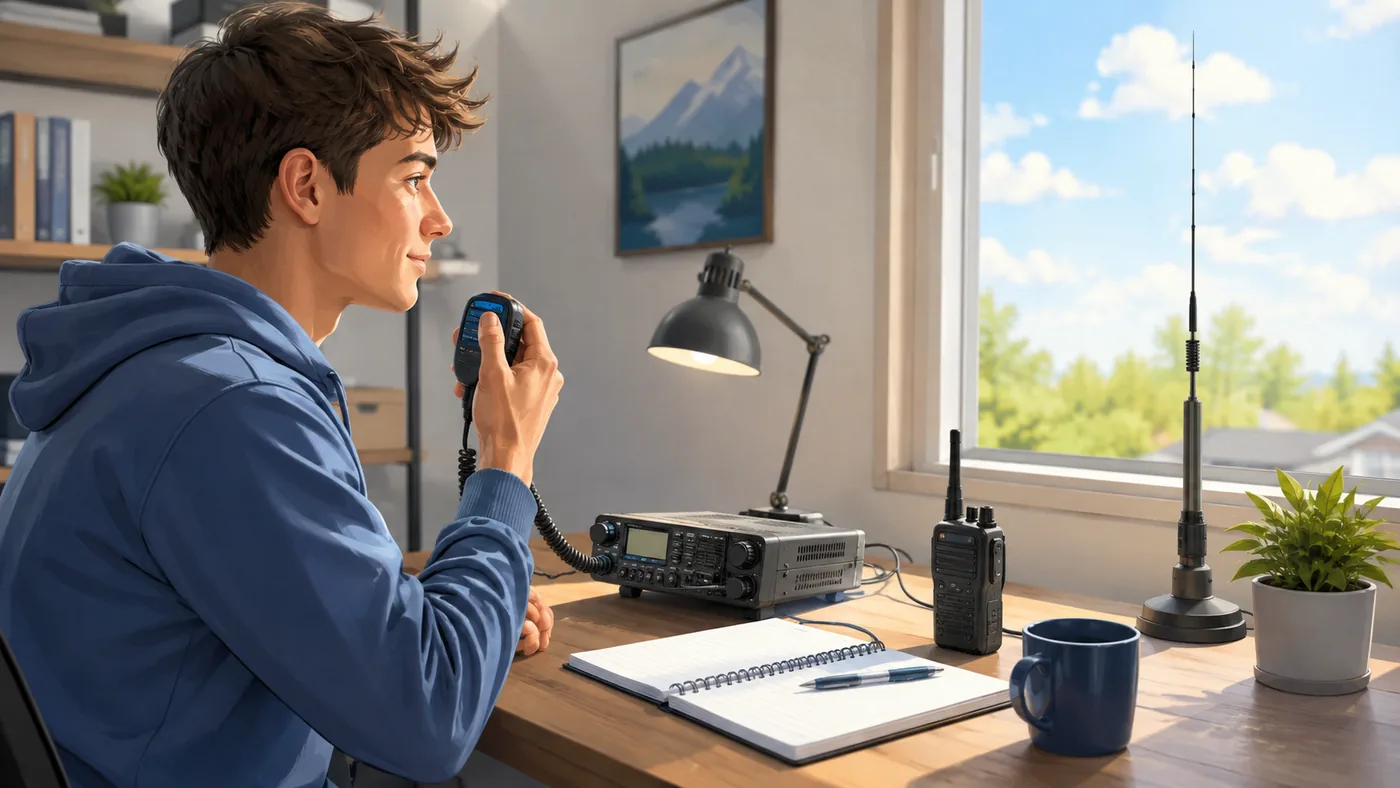
A handheld or modest VHF/UHF station can already teach you a lot. You can add an outdoor antenna, a 10-metre setup or more specialised equipment later. There is no need to buy an entire shack on day one.
Then comes the first QSO

Once the exam is passed and your licence and callsign are issued, the theory becomes practical: call signs, reports, bands, antennas and operating procedure suddenly have a purpose.
Is Class N easy?
I would call it deliberately approachable rather than effortless. You still need to learn. But it is a realistic entry point designed to let newcomers become responsible radio amateurs without requiring advanced electronics on day one.