
Commercial Assault from Orbit: Is Amateur Radio Losing the 70-cm Band to AST SpaceMobile?
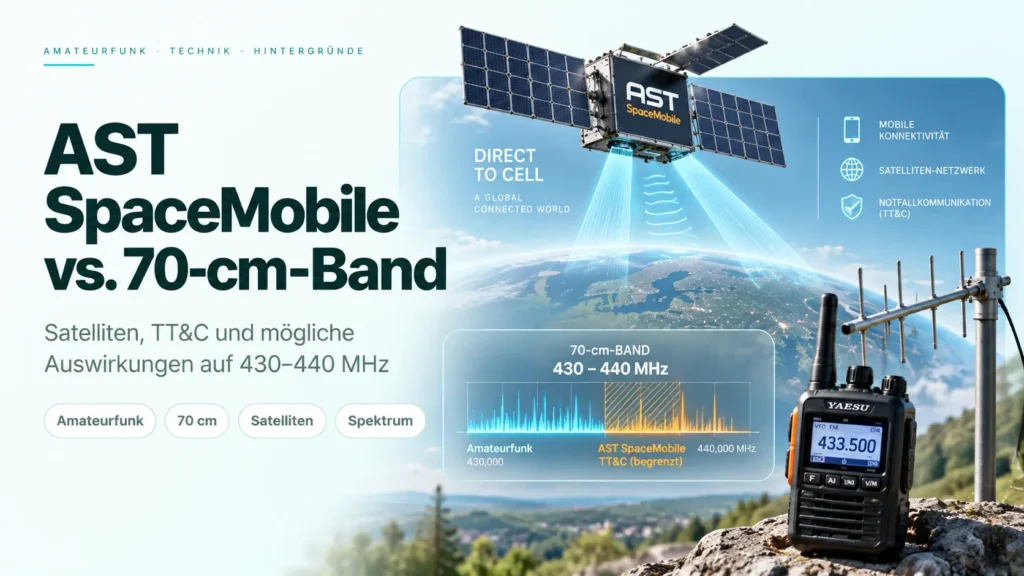
The FCC has approved AST SpaceMobile's permanent use of the 70-cm amateur band for a 248-satellite constellation. This decision poses a significant threat to German amateur radio relays, the new Class N beginner license, and AMSAT satellite projects.
News
AST SpaceMobile 70-cm band
AST SpaceMobile
70-cm band
AST SpaceMobile plans to use the 70-cm band (430–440 MHz) for its planned low-Earth-orbit (LEO) satellite constellation—a frequency range that is exclusively allocated to amateur radio in Germany and Europe. The US regulatory authority, the FCC, approved the use of this spectrum for the entire constellation of around 250 satellites in May 2026, despite protests from over 2,500 radio amateurs and associations worldwide. For the German amateur radio community, this means not only a potential interference problem but also an existential threat to the dense relay network and the new Class N beginner license.
Who is AST SpaceMobile and what do they want on our frequencies?
AST SpaceMobile (AST & Science LLC) is a publicly traded company based in Texas that wants to build a global mobile network from space. The goal is to connect unmodified smartphones directly via satellite with 4G/5G broadband—a service that is supposed to work without ground infrastructure. For this, the company plans a constellation of 243 to 248 extremely large low-Earth-orbit satellites, internally named “BlueBird.” Each of these satellites is to have its own telemetry, tracking, and control (TT&C) system. For the up- and downlinks of the TT&C, AST demands the release of the 430–440 MHz frequency range, i.e., the entire 70-cm amateur band.
The technical nightmare: How 248 satellites can cripple the band
The planned TT&C channels require a bandwidth of 64 kHz to 256 kHz per satellite. With almost 250 satellites, this creates a permanent interference footprint of several megahertz that occupies the entire 10-MHz-wide band segment. The signals are sent with a bandwidth of 50 kHz each—already in September 2024, AST tested five satellites on the frequencies 430.5 MHz, 432.3 MHz, 434.1 MHz, 435.9 MHz, and 439.5 MHz, without holding an official permit for doing so.
In comparison, established frequency bands are available for commercial satellite TT&C: S-band (2025–2110 MHz), X-band (8025–8400 MHz), and Ka-band (27.5–30.0 GHz). These bands are already reserved for military and commercial use and offer sufficient bandwidth for controlling large satellite constellations. ITU studies explicitly exclude the 70-cm band from commercial TT&C applications because it is a secondary allocated amateur band. AST is therefore turning to the 70-cm band because no license fees apply there—a clear cost and regulatory advantage for the company, but a risk for the amateur radio community.
A slap in the face for German relays and Class N
In Germany, the 70-cm band is home to a particularly dense infrastructure of FM and digital relays (DMR, C4FM, D-Star), digipeaters, and ATV transmitters. Many radio amateurs, especially beginners, use these relays to achieve coverage. The planned TT&C signals from AST, with a bandwidth of 64–256 kHz, would heavily load the input filters of relays. Even if the signals only occur sporadically, a single wide channel is enough to overload the receivers and block communication across the entire band.
The new German beginner license, Class N, is heavily focused on the VHF bands 2 m and 70 cm. Without functioning relays or with heavily disturbed frequencies, Class N licensees would lose their most important playing field for getting started. This means that a large part of the new generation of radio amateurs would be practically excluded from the hobby.
Additionally, the amateur radio satellite project AMSAT uses the 70-cm band for communication with its own satellites. A commercial user occupying the entire band would thus put the scientific and non-profit experimental projects of AMSAT in direct competition and jeopardize their usage rights.
The regulatory drama: How the FCC defied the protests
The path to approval was marked by several twists. In June 2025, the FCC accepted AST’s application for comment. Subsequently, over 2,500 objections from radio amateurs, including associations like ARRL, AMSAT-DL, AMSAT-UK, and the Open Research Institute (ORI), were submitted to the US licensing authority. In September 2025, the FCC reacted to the pressure and restricted the use to pure emergencies and a maximum of 24 hours per day. This partial success showed that broad protest can indeed have an impact.
However, the decision in May 2026 reversed the previous restriction: the FCC authorized the use of the 70-cm band for the entire constellation of 248 satellites. This means the temporary protective measure is definitively lifted, and a commercial operator gains permanent access to a band that is primarily allocated to amateur radio in Europe.
As early as 2023, the German federal government had asked AST to cease operations as soon as the satellites became visible over German territory—an indication that ITU regulations were violated. However, the current FCC decision makes this request difficult to enforce, because the US authority now declares the spectrum as primary for the commercial user.
Conclusion & Outlook: Do we have to yield now?
The FCC’s approval means that the 70-cm band will henceforth be permanently occupied by a commercial operator. For the German amateur radio community, this means a high risk of interference, especially for the dense relay network and the new Class N beginner license. The situation requires coordinated action by German associations (DARC, DARC-Region, BNetzA) and a clear stance towards European regulatory authorities to defend the primary allocation of the band to amateur radio.
One possible approach is to restrict AST’s use to emergencies while simultaneously demanding alternative frequency bands for TT&C communication. At the same time, amateur radio associations should increasingly emphasize the ITU regulations, which explicitly exclude the 70-cm band from commercial TT&C applications. Only through consistent international collaboration can the band be prevented from being permanently blocked by a commercial service.
73 & have fun trying it out.
More amateur radio, technology and practical articles are available on DA6IT.de.