FT8 has become a huge part of amateur radio. A few clicks, a bit of patience, and another DX contact ends up in the log. I enjoy that side of digital radio. But sometimes I want more than callsigns, reports and “73”. I want to have an actual conversation.
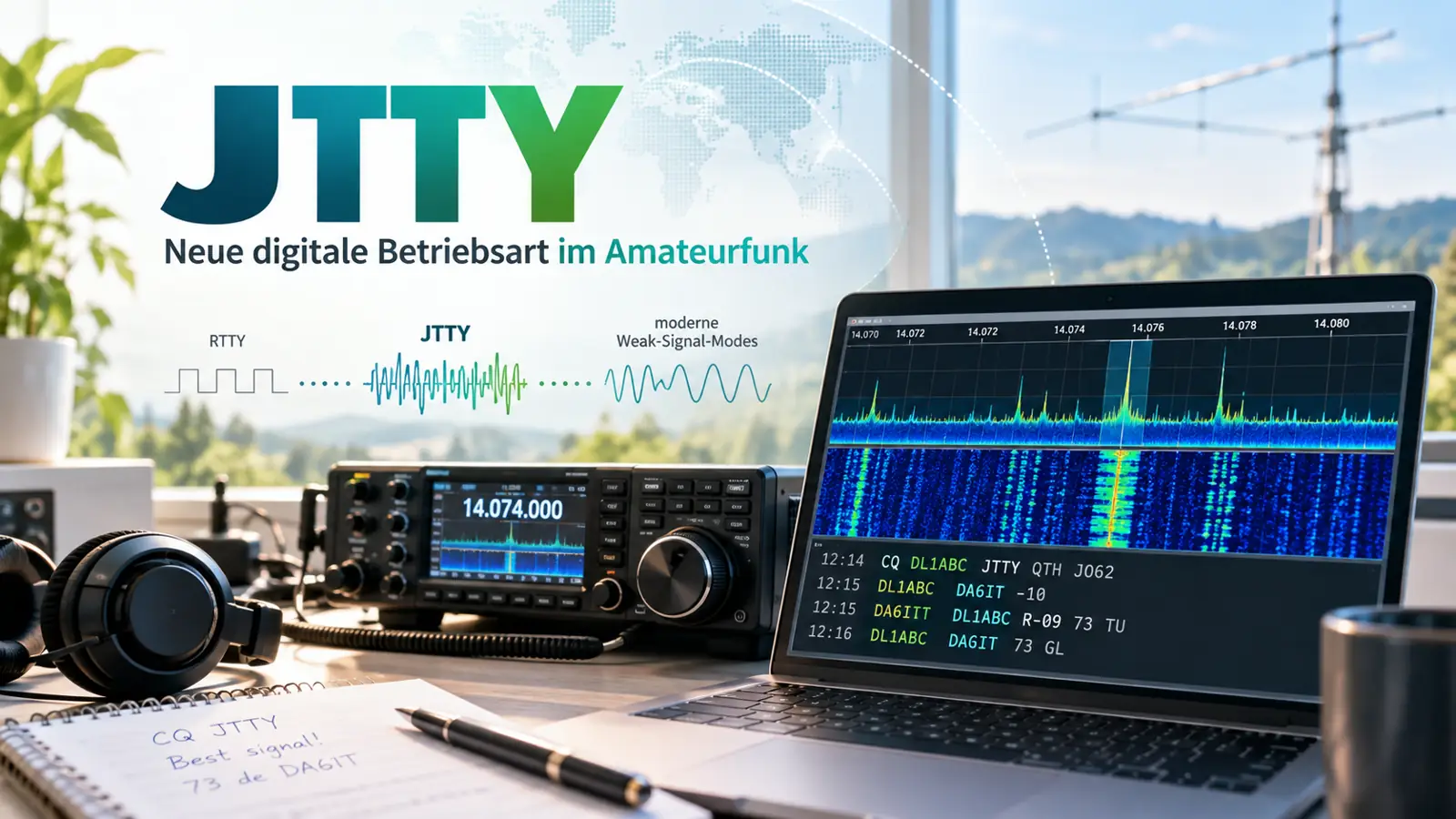
That is why JTTY caught my attention. The new digital mode, developed in the WSJT-X community around Joe Taylor, K1JT, aims to combine RTTY-style keyboard QSOs with modern weak-signal processing and forward error correction. It sounds promising – but I have not tested JTTY on the air yet. This article is my first look, not a hands-on review.
What exactly is JTTY?
Think of the classic RTTY experience: a radio connected to a computer, characters arriving on screen, and a reply typed directly from the keyboard. No rigid 15-second transmission slots and no conversation limited to a handful of standard exchanges. JTTY is built for both free-form keyboard chats and compact contest messages.
Unlike traditional RTTY, it includes error correction to improve reliable decoding under difficult conditions. That is a technical design feature, not a performance improvement I have personally measured.
Do we really need another digital mode?
We already have FT8, FT4, RTTY, PSK31, JS8Call, VarAC and many more. FT8 and FT4 are brilliant for short, efficient contacts using structured messages. RTTY and PSK31 offer a more conversational keyboard experience. JS8Call and VarAC already demonstrate that modern digital processing and longer text exchanges can work together.
JTTY is not inventing keyboard chat. What makes it interesting is its particular blend of RTTY-like interaction, short frames, modern decoding and contest-friendly message formats. Whether that combination feels better in practice remains to be seen.
The technology behind JTTY
For the technically curious: JTTY uses 4-GFSK modulation with four tones and forward error correction. The official WSJT-X documentation lists a symbol rate of 31.25 baud, an occupied bandwidth of approximately 125 Hz, frames lasting 1.888 seconds, and a rate-1/2 convolutional code. Transmissions are not tied to fixed UTC time slots.
Developer descriptions indicate roughly 30 words per minute for arbitrary text and up to around 60 words per minute for optimized contest exchanges. These are not numbers from my own tests. A good-looking specification does not automatically guarantee a smooth on-air experience.
The detailed protocol is covered in the official WSJT-X user guide.
On-air use: relaxed chats or fast contesting?
In principle, you can call CQ, exchange callsigns, send longer messages and sign off with 73 whenever the conversation is ready – without waiting for predefined slots. Macros and special message packing are intended to make contest exchanges fast as well. I am particularly curious whether both styles feel natural rather than awkward.
Software, beta status and early activity
As of 15 October 2026, the newest official pre-release is WSJT-X 3.3.0-beta2. The development team explicitly invites experienced operators to test the new mode and provide feedback. Expect some rough edges in beta software.
Joe Taylor reports daily JTTY QSOs, especially around 14.090 MHz, along with activity via QO-100 and 23 cm EME. That is encouraging, although initial activity does not yet tell us whether the mode will find a lasting audience.
See the official WSJT-X releases and Joe Taylor’s beta announcement.
Where can you find JTTY on the bands?
Even the best digital mode needs a common place to meet on the air. The WSJT-X development team around Joe Taylor has therefore suggested initial JTTY dial frequencies. For now, 14.090 MHz on 20 metres is the main meeting point, with suggestions ranging from 160 m to 2 m.
| Band | JTTY dial frequency (USB) |
|---|---|
| 160 m | 1.838 MHz |
| 80 m | 3.575 MHz |
| 40 m | 7.090 MHz |
| 30 m | 10.140 MHz |
| 20 m | 14.090 MHz – main meeting point |
| 17 m | 18.100 MHz |
| 15 m | 21.090 MHz |
| 12 m | 24.920 MHz |
| 10 m | 28.090 MHz |
| 6 m | 50.160 MHz |
| 2 m | 144.160 MHz |
Important: These are very preliminary suggestions from the developers, not exclusive JTTY allocations. They may change as activity grows. Always check the band plan and regulations that apply where you operate.
These are USB / USB-Data dial frequencies. The actual transmitted signal is above the dial frequency by the selected waterfall audio offset. And because JTTY has no fixed transmit slots, pick a clear spot before calling CQ.
The list comes straight from the September 2026 WSJT-X announcement. Many defaults can be restored under Settings → Frequencies → Reset, but doing so can erase your custom entries. If you maintain your own frequency list, add the JTTY frequencies individually.
What about logging?
For logging, ADIF 3.1.8 now defines JTTY as a submode of MFSK: MODE=MFSK and SUBMODE=JTTY. This provides a standard way to exchange QSOs, but each WSJT-X-to-logbook integration still needs real testing. Details are in the ADIF specification.
Will JTTY catch on? Stay tuned.
Maybe! But a good protocol also needs plenty of operators, working software and a reason to come back. I am less interested in declaring JTTY the next FT8 than in finding out whether it brings a little more actual conversation back to digital amateur radio.
I plan to give it a proper on-air try, make some real contacts, check the usability and decoding – and, most importantly, find out whether I actually enjoy using it. Stay tuned: once I have some practical experience, I will share what worked, what did not, and what it was really like.
73 de DA6IT